What is a Spider?
A spider is an arthropod of the order Araneae, and though they are typically misclassified as insects, they actually belong to the class of Arachnida.
Spiders can be found in most landmasses across the globe and there are more than forty-eight thousand individual species of the pest. There are very few habitats on the planet that are able to keep spiders at bay, with the only certain respite from the pest being the continent of Antarctica.
What Do They Look Like?
Considering the extreme diversity within the various species of spiders, it’s extremely difficult to provide a general description when you can expect to find spiders of every size and colour imaginable. However, generally speaking, spiders will have two main segments to their body, and their eight legs are heavily segmented and each will normally terminate in a varying number of claws – hunting spiders will typically have less, and silk-spinning spiders will have more.
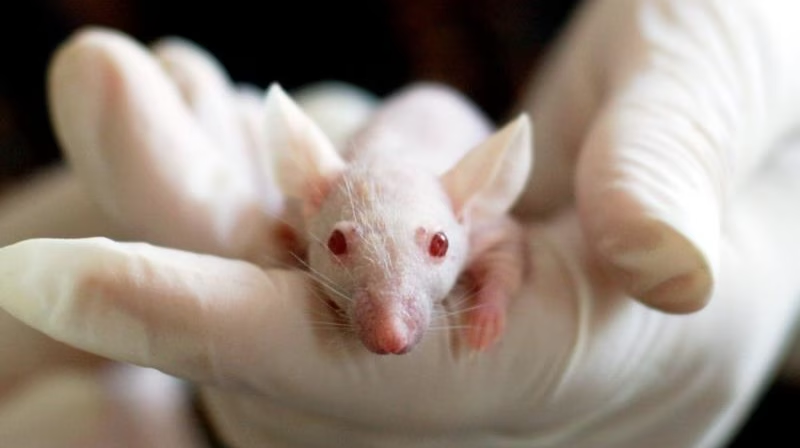
To distinguish a mouse from a rat, one must only look at the size of the creature in question. A mouse will be much smaller than a rat, though the two terms are not actually taxonomically specific, and species of both rats and mice can appear in a variety of genera and families.
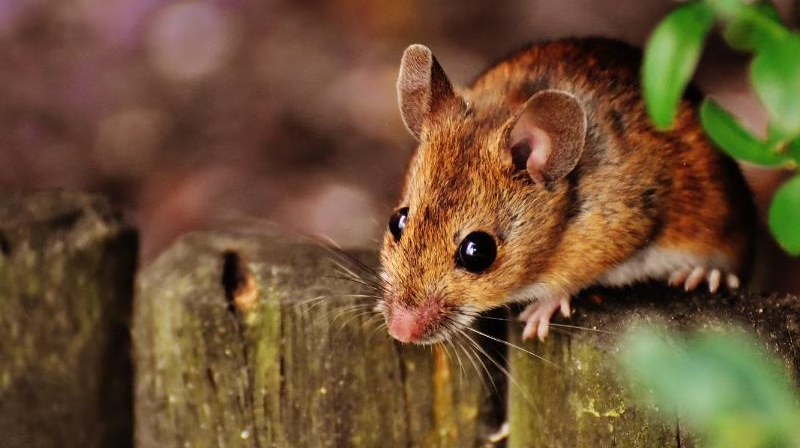
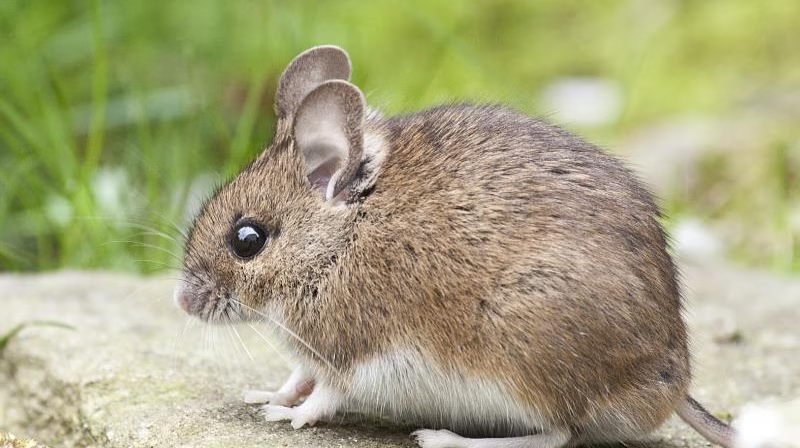
The mouse has a slender body, and its head either comes to a blunt or tapered point at its nose. Their ears are positioned at the top of their head just behind their two eyes, which leave the mouse well-equipped for their nocturnal lifestyle. Every mouse has four legs, each of which end in small, sharp claws, and the hind-pair of which are tipped in bald soles.
Mice are not thickly furred, with a thin layer of hair adorning their body. However, there is significant variation in the colour, texture, and density of the fur across different species, creating a vast range of possible coats for different mice. Some mice may have a soft, short, and dense coat of hair that may appear either woolly or velvety, while others will have spiny hairs running along both their underside and their upper body. The vast majority of mice, though, will have a moderately-thick coat that is either soft or slightly coarse of varying length.
Different species of mice are coloured differently. Some possible fur colours include grey, brown, white, and black, while their feet and underparts may be varying shades of grey to white. Curiously, their tail will be split into two colours, one for the upper side, and one for the underside.
The tail of a mouse varies significantly in length, with some species having shorter tails of about 3-6cm in length, while others may be longer, measuring at about 7-8cm.
When Are They Most Active?
Due to the extreme number of natural predators that mice face, most species of the creature are near-entirely nocturnal. Most mice are not seasonal, however, which means that while they will be more active in the night time, there is no particular time of year to be wary off, as mice are constantly scavenging for food at all times of the year. Despite that, both southern and eastern Australia can suffer from ‘mice plagues’ around once every four or so years. These plagues form due to a range of conditions, including the weather, food supply, and mouse population, and at their peak, can see the mice reaching a density of more than 1,200 mice an acre.
How Do They Form New Nests?
Mice create incredibly complex burrows, and in some species, the design of their burrow is a genetic trait passed down by each generation. These burrows are typically built of dry vegetation and consist of chambers connected by various tunnels, with some species opting to include a healthy selection of escape tunnels in the event that a predator manages to find its way inside.
To build their burrows, mice start by loosening soil with their incisor teeth, which they will then carry in their mouth to pile up outside of the burrow entrance. Alternatively, the mouse may instead choose to carry it into the burrow, where it will use its hind legs to position the dirt correctly. Via this technique, the mouse will reinforce the various chambers and tunnels of the burrow, creating a comfortable space to relax and rear young between foraging sessions.
Some species of mice don’t burrow in this way, and can instead be seen creating nests in more opportunistic locations, including inside of rock crevices, beneath rotting tree trunks, and in any sealed space within a human home. The diet of the mouse will shift to match the location of the burrow, which means mice living in the forest will eat seeds and plant matter, while mice living in human buildings are more likely to scavenge scraps of food.
What Risk Do They Pose?
Sadly, the mouse is a common carrier of all sorts of illnesses, including a range of viruses and parasites. Becoming infected by such an illness can be as simple as breathing dust that has been exposed to mouse excrement, as the mouse will excrete disease-laden feces. In addition to the significant health risk, mice have also been linked to structural damage as well as damage to farmer’s crops, both of which can present a significant strain to the local infrastructure.
Is There Anywhere In Particular Where They’re A Bigger Threat?
Mice are not particularly territorial and will likely avoid a direct confrontation with humans, but their mere presence in your home is extremely unsanitary and a significant health risk. If your home has mice present, it is best if you have them removed as quickly as possible.